2025
A Comprehensive Analysis of the Influence of Cognitive Load on Physiological Signals in Virtual Reality
Pina, J., Bernal-Berdun, E., Martin, D., Malpica, S., Real, C., Barquero, A., Armañac-Julián, P., Lazaro, J., Martín-Yebra, A., Masia, B., & Serrano, A. .
2025 IEEE International Symposium on Mixed and Augmented Reality (ISMAR), 433–443.
@inproceedings{11220375,
  author = {Pina, Jorge and Bernal-Berdun, Edurne and Martin, Daniel and Malpica, Sandra and Real, Carmen and Barquero, Alberto and Armañac-Julián, Pablo and Lazaro, Jesus and Martín-Yebra, Alba and Masia, Belen and Serrano, Ana},
  booktitle = {2025 IEEE International Symposium on Mixed and Augmented Reality (ISMAR)},
  title = {A Comprehensive Analysis of the Influence of Cognitive Load on Physiological Signals in Virtual Reality},
  year = {2025},
  volume = {},
  number = {},
  pages = {433-443},
  keywords = {Radio frequency;Visualization;Atmospheric measurements;Virtual environments;Psychology;Cognitive load;Particle measurements;Solids;Search problems;Physiology;Cognitive load;physiological signals;perception;visual search},
  doi = {10.1109/ISMAR67309.2025.00054},
  file = {ISMAR25-Biosensors-paper.pdf},
  image = {research/biosensors_thumb.png},
  project_url = {https://graphics.unizar.es/projects/CL_Biosignals/}
}
The study of cognitive load (CL) has been an active field of research across disciplines such as psychology, education, and computer graphics and visualization for decades. In the context of Virtual Reality (VR), understanding mental demand becomes particularly relevant, as immersive experiences increasingly integrate multisensory stimuli that require users to distribute their limited cognitive resources. In this work, we investigate the effects of cognitive load during a search task in VR, combining objective and subjective measurements, including physiological signals and validated questionnaires. We designed an experiment in which participants performed a visual search task under two cognitive load conditions (either alone or while responding to a concurrent auditory task) and across two visual search areas (90° and 360°). We collected a rich dataset comprising task performance, eye tracking, electrocardiogram (ECG), electrodermal activity (EDA), photoplethysmography (PPG), and inertial measurements, along with subjective assessments (NASA-TLX questionnaires). Our analysis shows that increased cognitive load hinders visual search performance and affects multiple physiological markers, offering a solid foundation for future research on cognitive load in multisensory virtual environments.
 2026Design and Evaluation of a Continuous Interface for Real-time Self-reporting of VR SicknessPlaza, M., Real, C., Serrano, A., & Gutierrez, D. .
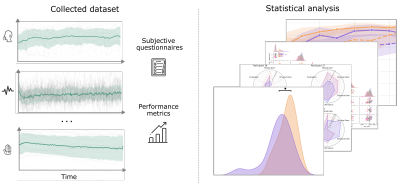 2025A Comprehensive Analysis of the Influence of Cognitive Load on Physiological Signals in Virtual RealityPina, J., Bernal-Berdun, E., Martin, D., Malpica, S., Real, C., Barquero, A., Armañac-Julián, P., Lazaro, J., Martín-Yebra, A., Masia, B., & Serrano, A. .